What Is Agentic AI CRM? The Complete Guide for B2C Businesses (2026)

Rishabh Kumar
Chief Product Officer
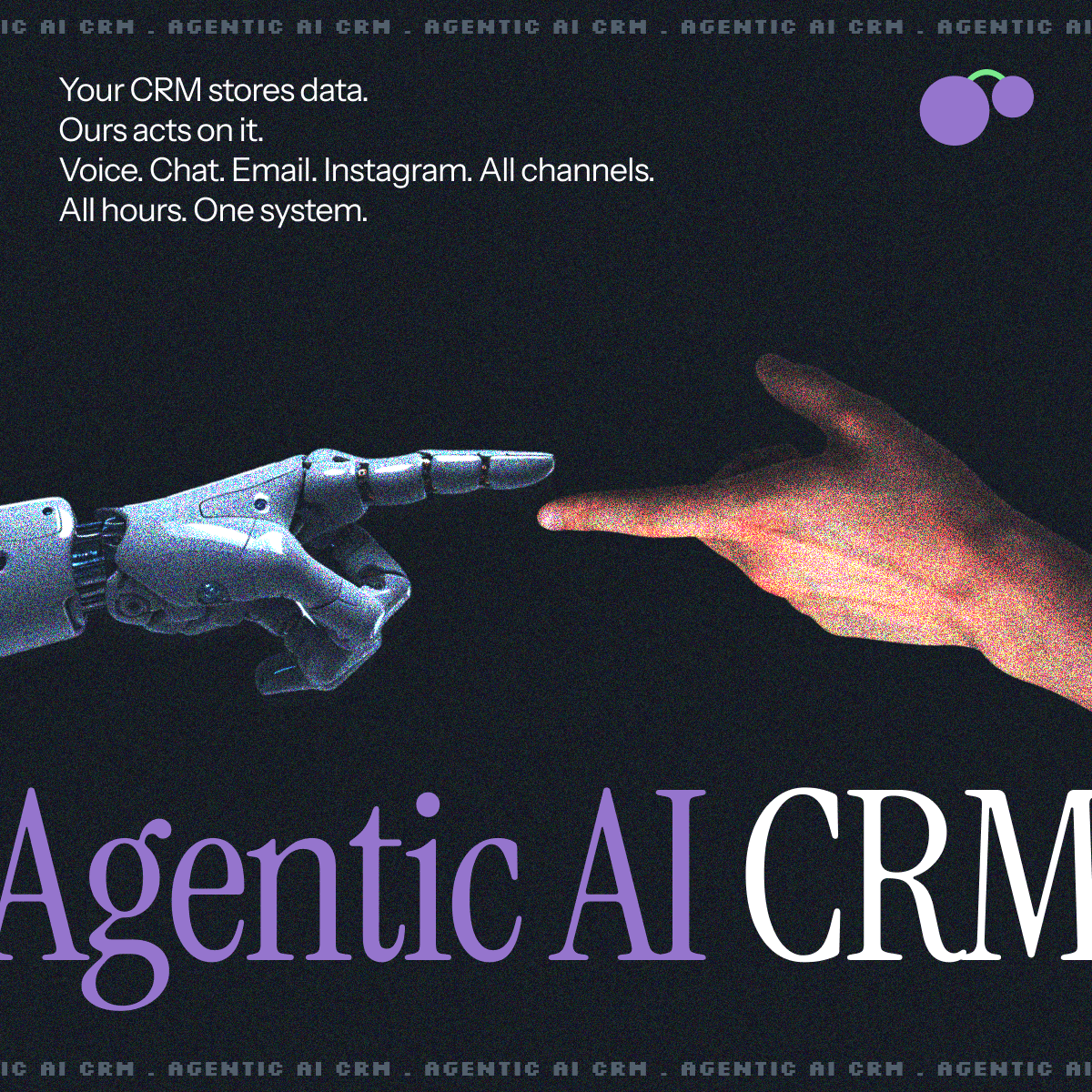
TL;DR: An Agentic AI CRM is a customer relationship management platform built AI-first, where autonomous AI agents (not bolt-on features) manage the full B2C customer lifecycle: from pre-sales lead qualification to post-sales support to remarketing. Unlike traditional CRMs that require human input to trigger actions, agentic systems decide and act on their own, across every channel (including voice calls, chat, email, and social), 24 hours a day.
Introduction: CRM Is Broken. Here's the Replacement.
If you run a B2C business and you've ever felt like your CRM was more of a database than a growth engine, you're not imagining things. Traditional CRMs were designed for a world where sales reps needed a place to store contact notes. They were never designed for a world where a customer expects to be recognised instantly, whether they call your support line at 2 AM, message on a chat channel at noon, or click a retargeting ad on Instagram three days later.
That gap between what customers expect and what legacy CRM tools deliver is the problem that Agentic AI CRM was built to solve.
In this guide, we break down exactly what an agentic AI CRM is, how it differs from every CRM category that came before it, and why it's become the single most important infrastructure decision for B2C companies in 2026.
What Is a Traditional CRM, And Why Is It Failing B2C?
A traditional CRM (Customer Relationship Management) system is a tool that stores customer data, tracks interactions, and helps teams manage relationships. Salesforce, HubSpot, Zoho: these are the household names.
They work well for B2B sales cycles where a human salesperson needs a structured pipeline and a place to log calls. For B2C, they fall apart:
B2C businesses deal with thousands to millions of customers, not dozens. Interactions happen across calls, chat, Instagram DMs, email, web chat, and voice, all simultaneously. Customers expect instant, personalised responses at any hour. Human agents can't scale to match volume without exploding costs.
The result? Most B2C companies end up stitching together 6 to 20 different tools: a CRM, a helpdesk, a messaging provider, a marketing automation platform, a CDP, an analytics layer, and a telecalling solution, each operating in a silo with no shared memory of the customer.
Industry Data: According to Backlinko research, organisations use an average of 112 SaaS applications. For growing B2C companies, managing 6 to 20 platforms across customer touchpoints is the norm, leading to data inconsistency, excessive SaaS spending, and customers who are forced to repeat themselves at every new touchpoint.
The Definition: What Is Agentic AI CRM?
An Agentic AI CRM is a customer engagement platform where AI agents, not features, not workflows, not rules, are the primary operating layer. These agents:
1. Understand full customer context across every channel and interaction in the lifecycle
2. Make decisions autonomously: escalate, respond, upsell, support, without human prompting
3. Act across multiple tools and channels simultaneously (voice calls, chat, email, Instagram, web)
4. Learn and improve from each interaction, refining their responses over time
5. Hand off to human agents seamlessly when nuance or empathy is required
The word 'agentic' is the key. An agent, in AI terms, is a system that perceives its environment, makes decisions, and takes actions to achieve a goal. An agentic AI CRM doesn't wait for instructions; it runs the customer relationship proactively.
Key Distinction: Traditional CRM: A database that humans query to take action. AI-enhanced CRM (e.g., HubSpot with AI features): A database with AI suggestions that humans still act on. Agentic AI CRM: A system where AI agents act autonomously on behalf of the business, using the CRM as their brain.
How Agentic AI CRM Differs From Other Categories
The CRM landscape has several distinct generations. Here's how they compare:
Generation 1: Operational CRM (Salesforce, Zoho)
Purpose: Store data, manage pipelines, log interactions. Human-driven. Built for B2B. AI is a bolt-on feature layer. Still requires humans to interpret data and take action.
Generation 2: Marketing Automation + CRM (HubSpot, WebEngage, CleverTap)
Purpose: Automate marketing sequences, email campaigns, SMS flows, push notifications. Better than Gen 1 for B2C scale, but still rules-based. Can't handle inbound conversations. Can't understand context dynamically. Siloed from support.
Generation 3: Conversational AI Platforms (LimeChat, Yellow.ai, Verloop)
Purpose: Deploy chatbots on messaging channels or web. Handle FAQs. Better for inbound, but single-channel, limited context, and disconnected from CRM data. Can't close the loop between a support conversation and a marketing campaign.
Generation 4: Agentic AI CRM (Angoor AI)
Purpose: Unify the entire customer relationship (acquisition, support, remarketing) under a single AI-native layer. Agents have full customer context, act autonomously, and operate across every channel simultaneously, including voice calls, telecalling, chat, email, Instagram, and web. The CRM is not just a storage layer; it's the intelligence layer.
What Does an Agentic AI CRM Actually Do? (The Full Lifecycle)
Pre-Sales: Acquisition & Conversion
Identifies products matching a customer's enquiry and presents them dynamically. Qualifies leads by asking contextually relevant questions, no scripted interrogations. Handles abandoned cart recovery autonomously over chat and voice. Manages reputation (collects and routes reviews) without human involvement. Makes outbound telecalls to high-intent leads using Voice AI for instant follow-up.
Post-Sales: Support & Retention
Provides real-time shipment tracking and delivery updates proactively. Handles return and refund requests end-to-end with integrations into logistics APIs. Captures feedback and routes to product/ops teams automatically. Escalates complex issues to human agents with full conversation context already summarised. Initiates Voice AI calls for sensitive issues like high-value complaint resolution.
Marketing: Remarketing & LTV Growth
Builds custom audience segments from CRM behaviour data and pushes to Meta Pixels. Runs retargeting campaigns triggered by support or product interaction signals. Identifies at-risk customers (low engagement, complaints) and triggers re-engagement flows across channels, including personalised telecalls for high-value segments.
Real Result: StudentTenant.com, a UK student property platform, deployed Angoor AI's agentic CRM and achieved 83% ticket automation, zero first response time, 67% increase in lead engagement, and 3x faster resolution times. Full implementation took just one week.
Why Is 2026 the Tipping Point for Agentic AI CRM?
Three forces converged in 2026 to make agentic AI CRM not just viable but necessary for competitive B2C businesses:
First, LLMs matured enough to handle nuanced customer conversations without scripting, across both text and voice. Second, conversational APIs (messaging, voice, social) opened at scale, making omnichannel the default rather than the exception. Third, SaaS fatigue hit critical mass: businesses couldn't operationally sustain 10 to 15 disconnected tools.
The result is that brands who deploy agentic AI CRM now are not just getting efficiency gains; they're building a structural competitive advantage that becomes harder to replicate as their AI accumulates more customer context over time.
Who Should Use an Agentic AI CRM?
Agentic AI CRM is built for B2C businesses with high customer interaction volume. Ideal candidates include:
E-commerce and D2C brands handling post-order support and abandoned cart recovery. Real estate platforms managing property enquiries at scale (lettings, student accommodation, rentals). Consumer app companies (astrology, health, fitness, finance) with chat-first and voice-first engagement. EdTech platforms qualifying and onboarding high volumes of prospective students. Healthcare businesses managing patient or recruitment communication via calls and chat.
Frequently Asked Questions
Q: Is an agentic AI CRM the same as a chatbot?
A: No. A chatbot is a single-channel, scripted or semi-scripted conversational interface. An agentic AI CRM is an entire customer engagement operating system. It includes conversational AI but also manages data, actions, integrations, escalations, and remarketing autonomously across every channel, from chat to voice calls to email.
Q: How is Angoor AI different from HubSpot or WebEngage?
A: HubSpot and WebEngage are built for marketers managing campaigns. Angoor AI is an AI-native platform where agents manage the full customer lifecycle (pre-sales, support, and remarketing) in one unified system. Angoor AI replaces 6 to 20 tools that B2C companies currently use.
Q: What channels does agentic AI CRM support?
A: A complete agentic AI CRM like Angoor AI supports voice calls (including Voice AI telecalling), Instagram, Whatsapp, Email, Web Chat, and messaging (SMS/RCS), with unified context across all of them.
Q: How long does implementation take?
A: Angoor AI's implementation timeline is typically one week. The StudentTenant case study involved full deployment across four phases: business process analysis, technical integration, agentic flow configuration, and analytics setup, completed in seven days.
Conclusion: The CRM Paradigm Has Shifted
The question for B2C businesses in 2026 is no longer whether to adopt AI. It's whether your AI is truly agentic, or just a feature bolted onto a legacy system. The difference in business outcomes is not marginal. It's the difference between a support team drowning in tickets and an AI system that handles 83% of them autonomously, across chat, voice, and every other channel your customers use.
Agentic AI CRM is the infrastructure layer that will define customer experience leadership in this decade. The companies that deploy it now will have a compounding advantage (more customer context, better AI performance, lower operational cost) that grows wider every month.
Want to see an agentic AI CRM in action for your B2C business?
Book a free demo at angoor.ai/demo-page
Rishabh Kumar
Chief Product Officer
Subscribe to our mailing list
We won't spam, just notifications when we are putting out something important.